Categories
Privatization Welfare state

Beyond social democracy: new institutions, new subjects

So many of the debates on the contemporary left come back to the legacy of social democracy. The Swedish experience came closest to fulfilling social democratic ideals in the post-war era and so speaks to these debates in a unique way. Earlier this year, I talked to Petter Nilsson of Sweden’s Left Party about the legacy of social democracy in his country and its broader meaning. This was one of my favourite interviews of the year and one that stuck with me for a long time. I’ve transcribed it here for it to be shared more widely. It’s been edited for length and clarity.

Michal Rozworski: Sweden is still seen by many around the world as a model for the welfare state but it has changed dramatically over the past couple decades. Can you give a quick summary of what it means to look at Sweden, as you’ve put it, “without illusions”?

Petter Nilsson: There’s this joke on the Swedish left that everyone would want the Swedish model and the Swedes would want it perhaps more than anyone. What’s considered to be the Swedish model peaked in maybe the late 70s, early 80s and has since gone through quite the same developments as the rest of Europe with the neoliberal wave. Because Sweden started at a high level of wage compression and equality terms of gender, it is still very equal compared to other European countries. Yet, at the same time, we have the fastest growth in class differences within the OECD.

When the Social Democrats turned rightwards in 1986 or so, a lot of the developments that had taken place in other European countries came to Sweden in a few swift blows. In just a few years we had huge increases in class differences and this affected our universal welfare system. This system was always based on the high wage compression, which included the middle class in same welfare system as the rest. Its members felt that since the quality of welfare programs was so high, they were prepared to pay taxes to finance them. But as soon as financing for the welfare sector is cut, then quality drops and the middle class opts out for private solutions.

Categories
British Columbia Climate change Privatization

No to pipelines, yes to Site C?

Here’s a piece I wrote for Ricochet after getting riled up by *some* of the arguments against Site C. The full piece is here.

As the movement against pipelines rapidly grows, more and more often you can hear the question, “We know what you’re against. What are you for?” The debate over the future of power generation in British Columbia offers some lessons for how to answer this question and not fall victim to a privatized green vision.

image

Tuesday the B.C. government decided to give the long-delayed Site C dam the green light. The dam would be the third on the Peace River in northeastern B.C. It will produce enough electricity to power nearly half a million homes (or one or two liquefied natural gas plants), flood around 50 square kilometres of land and cost almost $9 billion.

The decision has reinforced the polarized tenor of debate over Site C in B.C. On one side are local groups, First Nations, and environmentalists; the governing B.C. Liberals and business organizations stand opposite.

At first glance, Site C is what the left has been going on about for a while: major, green, public infrastructure. Not only does Site C fit this billing, but it could power further green initiatives like a mass electrification of transportation. It would also be very efficient: relatively little land would be flooded given the power generated, because the Peace River is already twice dammed.

Of course, the picture is not so simple. First, the proposed dam has not seen a transparent and independent review process; in fact, it has been exempted from the standard BC Utilities Commission review process. Second, the territory to be impacted is First Nations treaty land and hosts farming communities. Not only would construction of Site C inhibit farming, hunting, fishing and other uses of the land, but Canadian courts have recently confirmed the necessity of respecting and accommodating Aboriginal title. Finally, Site C has been so beloved by the Liberals and the business community because it could eventually supply cheap power to planned liquefied natural gas and mining industries — clean power for dirty industry.

Of these three, the liquefied natural gas industry looks to be on increasingly shaky ground. Critics point to concerns about what will be done with the power generated by Site C given much lower demand outlooks without LNG. Yet while mass electrification of transportation is not on the horizon, projects like Site C are built for decades. The major issue is lack of First Nations accommodation and due process. Without a transparent and democratic process, it is small wonder that the proposed dam has been a flashpoint of anger and protest.

Taking a wider view, Site C is emblematic of something much broader that has relevance across Canada: how do we support genuine green alternatives? This question is about much more than how we generate electricity; it’s about the narrowing of choices and a necessary response that reaffirms the public sphere.

Categories
Ideology Privatization Tax

Some thoughts on social democracy starting from a Fraser Institute graph

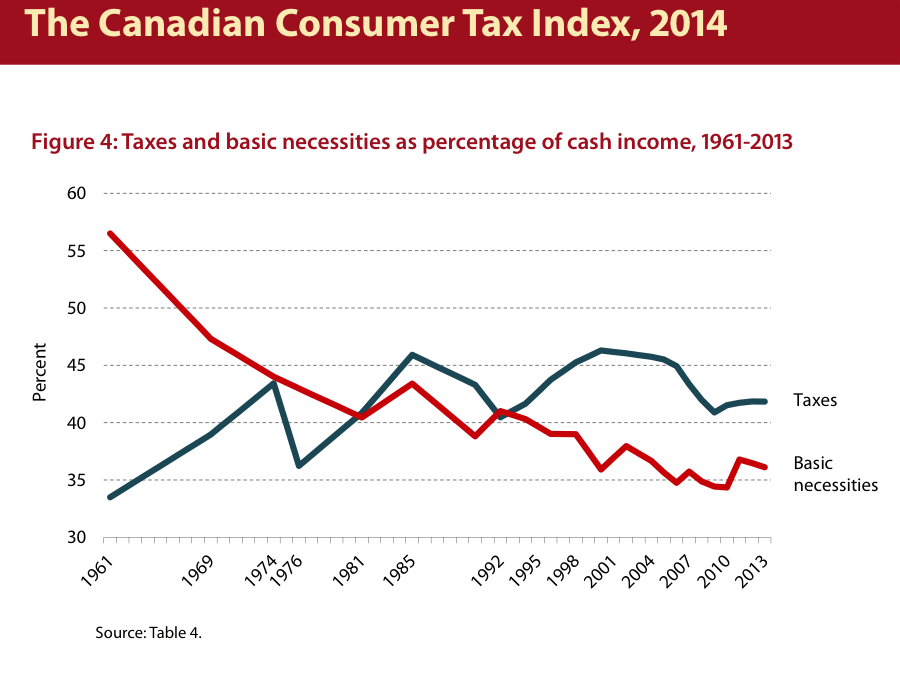
I’ve been meaning to post something on a chart from a Fraser Institute report for a while but slept on it. The chart comes from Fraser’s annual Consumer Tax Report and is supposed to show the different paths taken by how much households pay in taxes and how much they spend on basic goods like food and housing. 141209 fraser chart

In one way, this chart represents a good news story for the right. Capitalism is fulfilling one of its major promises: the cost of the basic goods is decreasing relative to household budgets – in the aggregate, which given an increasingly unequal distribution of income means that many budgets feel this very differently. Not only that, but the welfare state is slowly shrinking. Looking closely at the chart (showing the Fraser Institute’s version of the data), we see that the relative tax take is falling since about the turn of the millennium. Of course, the chart is riddled with errors (in short, the Fraser Institute either uses too many taxes or too little income in its measures) but better OECD data shows roughly the same trend, at least for taxes.

141209 canada tax-gdp

Ironically, while a story about lower spending on necessities could be a success story (capitalism works!), of course, that’s not the point of the exercise. Instead, the chart is intended to incite anger about taxes. The big caveat being to ignore the services these taxes actually pay for: the much-lower tax bill from 50 or 60 years ago is before universal healthcare, the Canada Pension Plan and other major elements of Canada’s welfare state. Yet in its ideological fervour, the Institute might be on the right track, because what the chart shows is in fact not just a success story but the changing nature of consumption. It illustrates how what economists once called the “subsistence wage” – where subsistence is not like a fixed number of calories, square feet and so on but culturally-relative and so varies according to time and place – has changed: most strikingly, what part of consumption is privately-provided and what part is socialized and provided by the state.

Categories
Canada Political Eh-conomy Radio

Talking Canada’s economy with Jim Stanford


Today’s episode is the last of 2014 as I’ll be away spending the holidays with family. For a bit of a year-end summary of Canada’s economy, my one guest is Jim Stanford who joins me for an extended conversation. Jim is the chief economist at Unifor, Canada’s largest private-sector union, and author of the popular economics book Economics for Everyone. Our chat touches on everything from the consequences of the falling oil price to the new batch of free trade agreements to Canada ‘s economic standing stands six years out from the global meltdown all the way to popular economic education and its lessons for today. My conversation with Jim Stanford.

As always, you can subscribe to the podcast on iTunes. You’ll hear from me again in 2015!
Categories
British Columbia Privatization Technology

No thanks Uber, I’m not signing your petition

So the ride-sharing app Uber is urging Vancouverites to sign a petition on its site to put pressure on the City to allow Uber to operate. An ad for the petition invaded my Twitter feed and I decided to take a closer look. Here’s the petition with my commentary. Spoiler: no, I’m not signing.

Uber begins by laying out “the situation”:

British Columbia and Vancouver are home to the quintessential winter playground, shining examples of liveable cities, and a launching pad for countless innovators and trailblazers across many industries.

That’s why so many residents are disappointed by Vancouver’s limited transportation options. To make matters worse, the Province of British Columbia, at the behest of the taxi industry, isn’t putting consumers first or thinking about how new innovations can create better transit solutions for all.

The ridesharing industry is a very new one, but cities all over the world are embracing it as a way to address the shortcomings of mass transit, reduce congestion and emissions, connect previously isolated neighborhoods, and overall bring cities together in a way never before imagined. These are benefits that people are experiencing right now in more than 220 cities around the world — but Vancouver isn’t among them.

Why thanks, we are quintessential innovators…wait a minute. Once we get past the sweet talk, Uber here points to a real problem, but offers a false solution. Transit shortcomings? Better transit is a worthy goal, only the natural solution would be more buses, lower fares and better service rather than deregulated taxis. The context for transit shortfalls is the systemic offloading of costs from the province government onto cities and an unwillingness to cover increased demand by taxes — at the same time as road infrastructure is rapidly expanded.

Isolated neighbourhoods? Granted, but again this is more a failure of urban planning than something that be solved by an app that helps people catch a cab. This is a perfect illustration of the hubris of Silicon Valley: the gap between pressing problems and technological quasi-fixes that enrich the Valley’s venture capitalists. The environmental benefits too may be overblown: ridesharing is certainly better than single-passenger driving but there is evidence that as Uber cuts prices, drivers have to spend more time driving looking for passengers. A car will always be much less environmentally-friendly than a bus or a subway and any system based on more cars will naturally push for more road infrastructure. Vancouver’s history at least has shown this can come at the cost of transit improvements.wpid-wp-1417653452329.jpeg

Uber isn’t interested in better transit or better public infrastructure: it’s interested in getting market share for its app. Its rationale for entering a city makes even more sense when other options are bad: the shittier the transit, the worse the regulated taxi industry, the better. And all the talk about a taxi lobby that has politicians in its back pocket is a bit rich for a company that hired its own prominent lobbyists in BC, likely only the beginning. In short, Uber is fighting a public funding shortfall with privatization, public policy failures with undersize techno-fixes, lobbying fire with lobbying fire.